Web Development
Willow Weave
I moved Willow Weave, a young women's clothing label in Pakistan, off Shopify and onto a custom storefront and admin dashboard that costs nothing to run beyond the yearly domain fee.
Project snapshot
| Client | Willow Weave, women's 2-piece and 3-piece suits, tops and trousers |
| Scope | Custom webstore, owner/staff dashboard, transactional email |
| My role | Design, full-stack development, deployment |
| Stack | Next.js front end on Cloudflare, Supabase (database, auth, backend), Cloudinary (media), Resend (email) |
| Running cost | Free tiers only; the domain is the single recurring cost |
| Live site | willowweave.co |
The problem
Willow Weave was paying Shopify every month before the store was earning enough to justify it. For a new local business, a fixed platform fee is one of the few costs that arrives whether or not anyone buys.
The money wasn't the only friction. On Shopify the brand's look was boxed in by the platform:
- Themes: the free options were limited; anything distinctive meant buying a premium theme.
- Layout: sections could only be arranged the ways the theme allowed.
- Design details: font choices and other brand-level styling were restricted.
The owners wanted a store that looked like Willow Weave, not like a Shopify template, without taking on a new monthly bill to get there.
Goals
- Full design freedom. A storefront built around the brand, with no theme, layout or font limits.
- Zero running cost until the store earns. Host everything on free tiers so the business pays nothing while it builds an audience.
- Costs that scale with revenue. When traffic outgrows the free tiers, paid usage should cost the same as Shopify's monthly fee or less, and only arrive once sales can cover it.
- Keep what mattered from Shopify. Rebuild the analytics and admin features the owners actually used, and nothing they didn't.
- Owner control without a developer. Let the team update the homepage for each launch or occasion themselves.
- Mobile-first for everyone. Customers shop on their phones, and the owners run the business from theirs.
Architecture and the cost model
Every piece of the stack was chosen for two things: it does its job well, and its free tier is generous enough to carry a new store.
| Service | What it handles | Why it fits |
|---|---|---|
| Cloudflare | Hosts and serves the Next.js storefront and dashboard | Global edge network, free hosting for sites at this scale |
| Supabase | Database, authentication, backend logic | Postgres with auth and access rules built in, no server to manage |
| Cloudinary | Product photos and campaign imagery | Resizes and converts images on the fly, so pages stay fast on mobile data |
| Resend | Order, cancellation, alert and login emails | Developer-friendly transactional email with a usable free allowance |
The result: the store runs for the price of its domain name. No hosting bill, no platform subscription, no theme purchase.
The model is built to grow with the business rather than ahead of it. Costs only start once real traffic pushes past the free limits. By then, the store is earning from that same traffic, and the combined paid tiers are expected to land at or below the US$25 plus tax that Shopify charged each month.
The storefront
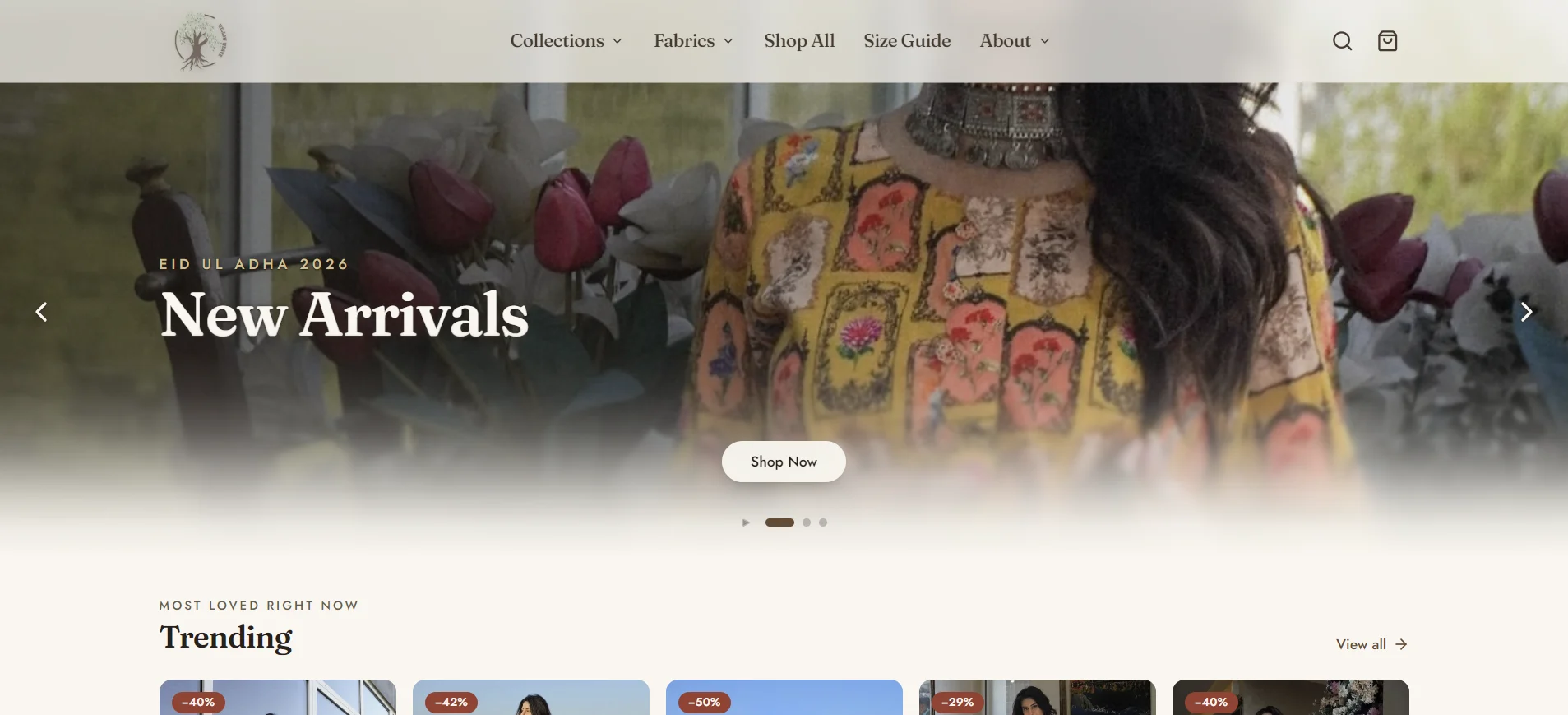
Freed from theme constraints, the storefront is designed around how Willow Weave actually sells: in numbered seasonal volumes, occasion drops and fabric stories.
- Navigation that matches the catalogue. A mega menu lets shoppers browse by volume (e.g. Volume 5 – Sun-Kissed Threads), by occasion (Eid collections), by piece (2-piece, 3-piece, tops, trousers) or by fabric, from chiffon and karandi to velvet.
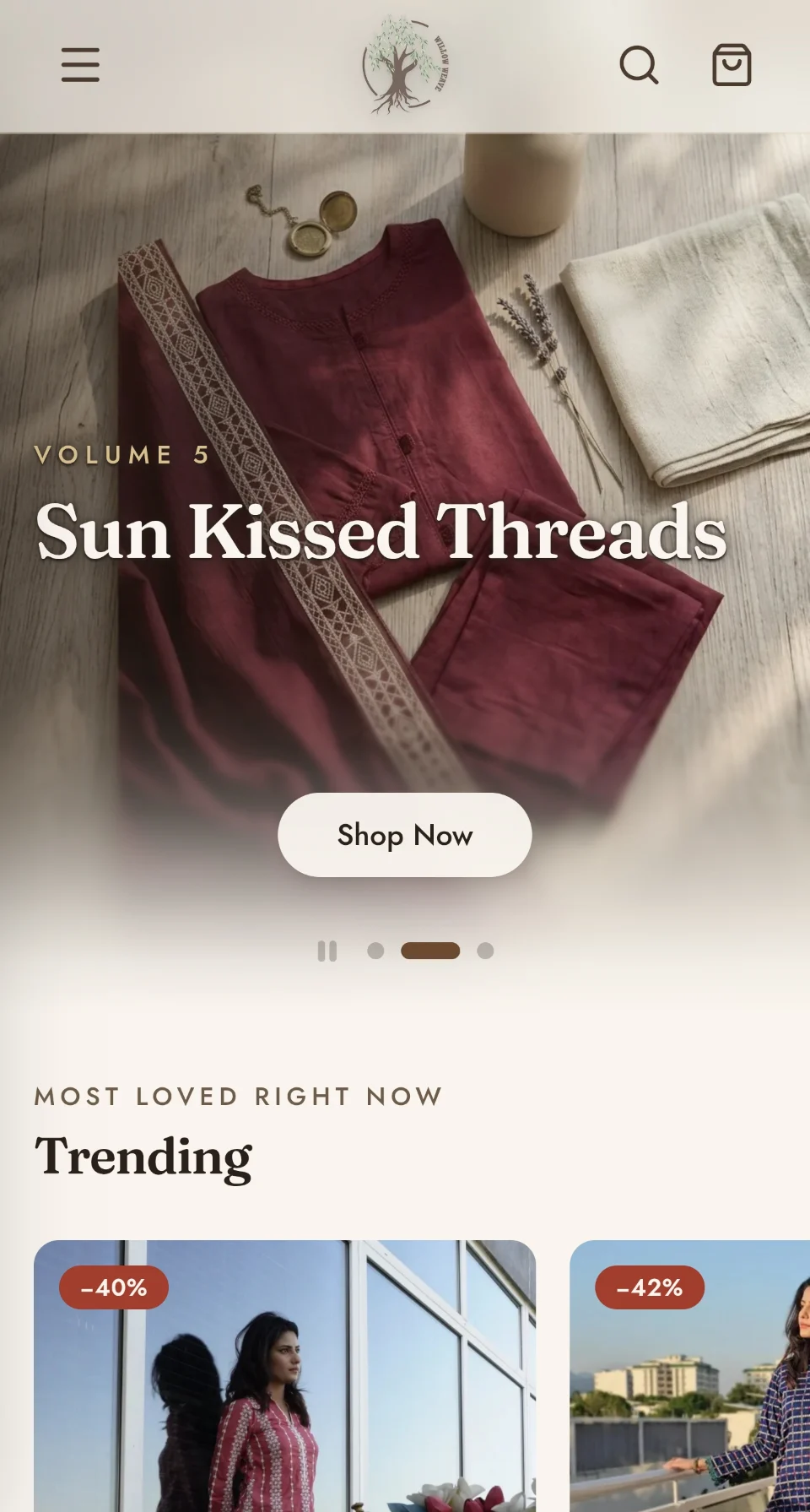
- Brand-led presentation. Custom typography, a warm palette and editorial hero sections for new arrivals, current volumes and bestsellers.
- Built for the local market and beyond. Cash on Delivery across Pakistan, worldwide shipping, and a display-currency switcher covering PKR, USD, GBP, EUR, AED, SAR, CAD and AUD.
- Shopping aids. Sale pricing with discount badges, sold-out states, and a size guide with fitted-garment charts and notes for relaxed silhouettes.
- Fast on phones. Images are served through Cloudinary in the right format and size for each device, and every page is responsive.
- Support where customers already are. WhatsApp, Instagram, Facebook and TikTok are linked throughout.
The dashboard
The dashboard rebuilds every Shopify feature the owners asked for, then adds control over the storefront itself.
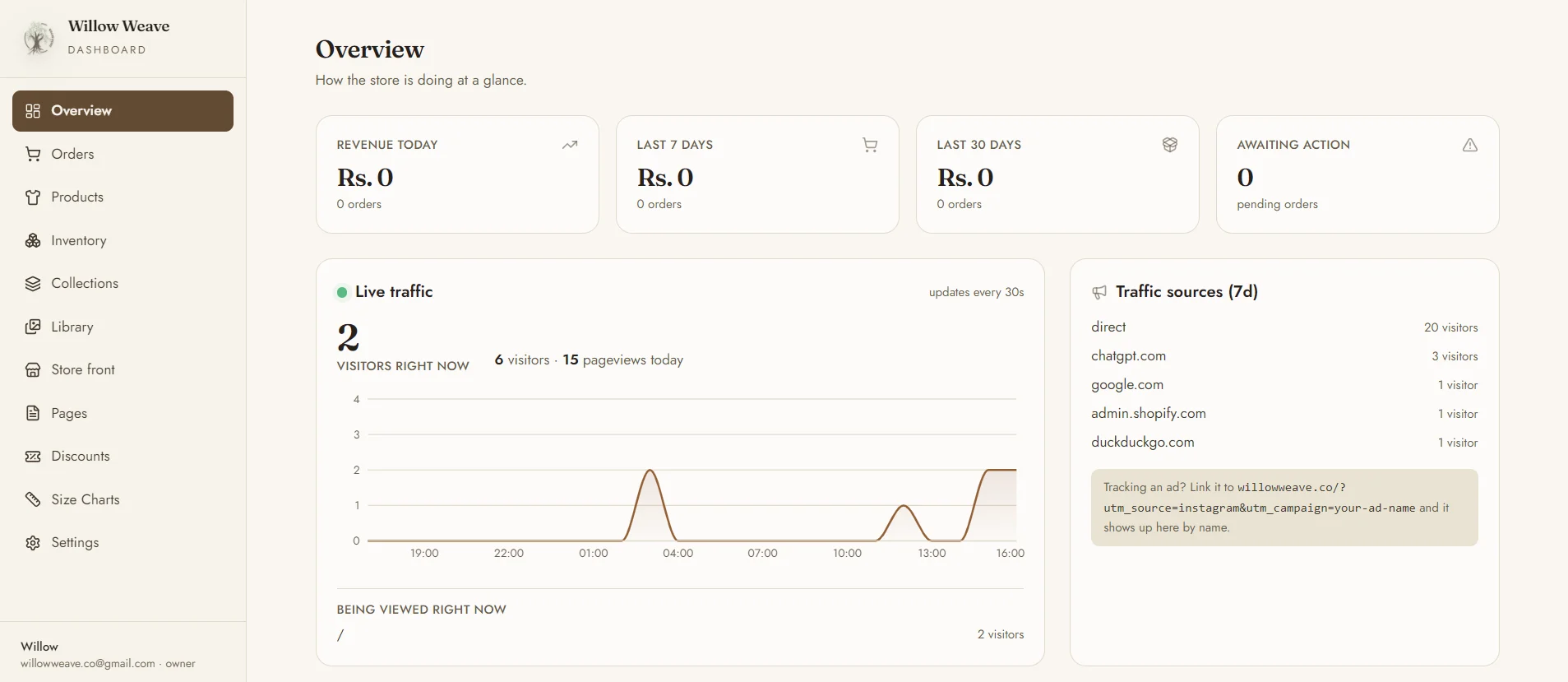
Knowing how the store is doing
- Live traffic monitor showing who is on the store right now.
- Revenue at a glance, broken down daily, weekly and monthly.
- Top-performing products, so restocks and promotions follow real demand.
- Ad traffic by platform, counting visitors from Instagram, Facebook and other sources, so the owners can see which channels are worth their ad spend.
Running campaigns without a developer
Willow Weave's calendar is driven by launches, drops, new arrivals and occasions like Eid. The owners can reshape the homepage for each one from the dashboard:
- Edit the hero and the other showcase sections.
- Add an announcement banner and set its colour.
- Rearrange and edit the header menu.
A homepage refresh for a new volume or a holiday sale is now a few minutes' work for the owners, not a request to me.
Security, roles and store settings
The admin side is locked down in layers, because a store's dashboard holds its customers' orders and its revenue.
- Email OTP login. Every dashboard sign-in requires a one-time code sent to the account's email.
- Owner and employee roles. Staff can handle day-to-day work, while sensitive actions stay with owner accounts.
- Store settings. Owners manage shipping regions and currencies, and create discounts and discount codes.
Transactional email
Resend handles every automated email the store sends:
- Order confirmations and cancellation notices to customers.
- Instant new-order alerts to the owners.
- One-time login codes for the dashboard.
Like the storefront, the dashboard is fully responsive, so owners and staff can check sales, fulfil orders and update the homepage from a phone.
Outcome
Willow Weave now runs a fully custom store, with more than 50 products across five volumes and two Eid collections, for the cost of a domain name.
- The monthly platform fee is gone. That's US$25 plus tax a month, over $300 a year, kept in a business that is still finding its footing.
- The brand looks like itself. No theme purchase, no layout ceiling, no font restrictions.
- The owners run their own campaigns. Homepage changes for drops and occasions happen from the dashboard, on their phones.
- Growth won't break the budget. Hosting costs only begin once traffic, and therefore revenue, justifies them.
Early results
The store launched recently and sales follow Willow Weave's drop calendar, so there are no revenue figures yet. The early signals are about reach, quality and usability.
- Organic traffic with no ads. 19 visitors in the last 7 days, measured by the dashboard's own tracker, including referrals from AI assistants such as ChatGPT. It's an early sign the SEO and answer-engine optimisation are paying off.
- Owners who can use it. One of the owners, with little technical background, found the dashboard easy to learn and use.
| Lighthouse, mobile (0–100) | On Shopify | Custom store |
|---|---|---|
| Performance | 49 | 75 |
| Accessibility | 94 | 93 |
| Best practices | 75 | 100 |
| SEO | 92 | 100 |
Scores are for mobile, where most shoppers browse. Performance rose 26 points, best practices and SEO reached a perfect 100, and accessibility held steady.